No Clock, No Coach, No Agenda: The Outdoor Chess Table Is Becoming America’s Easiest Hello
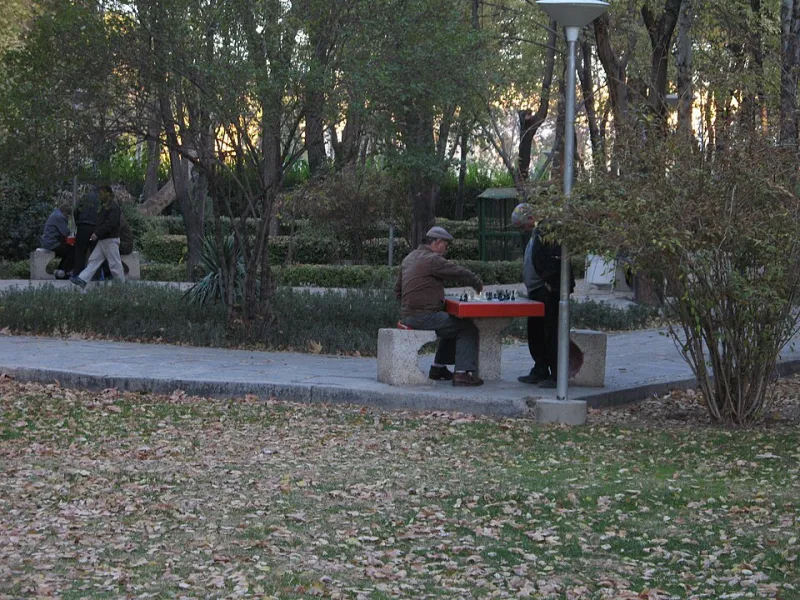
Photo: Ivan Mlinaric from Slovenia, CC BY 2.0, via Wikimedia Commons
On a recent Saturday afternoon, the busiest table in a Columbus, Ohio, park wasn’t selling anything. It wasn’t hosting a class, either. Two retirees were bent over a plastic chess set, a teenager was watching with one earbud out, and a woman with a grocery bag had stopped to ask who was winning. Nobody quite knew. The game had been going for forty minutes, and the conversation had already drifted from pawn structure to the price of eggs.
That scene is repeating in more American cities than you might expect. Not as a tournament. Not as a club with dues and a newsletter. Just a table, some pieces, and the assumption that someone will eventually sit down.
The Table Does the Introducing
Outdoor chess tables have a way of making public space feel less public. A bench invites you to sit alone. A playground invites you to supervise. A chess table invites you to look at another person and guess what they’re about to do. That small act of attention is enough to start a conversation.
In practice, the tables show up in ordinary places: a library courtyard in Tucson, a bar patio in Asheville, the grassy edge of an apartment complex outside Minneapolis. Some are concrete fixtures with built-in seats. Others are lightweight folding tables that get carried out on Friday evenings and chained back up before rain. The common thread is not the furniture. It’s the permission slip.
“You don’t have to be good at chess to sit at a chess table,” says a parks planner in Portland who has watched a handful of tables become unofficial neighborhood anchors. “You just have to be curious. That’s a much lower bar than people think.”
A Very Old Game With a Very New Social Job
The game itself is not having a sudden renaissance because of a rule change or a viral app. Chess has been a street-corner fixture for generations. Washington Square Park in New York has hosted outdoor chess players since the 1960s, and the sight of speed chess under the arch is practically part of the city’s furniture. Moscow’s parks have long had chess pavilions and shaded boards where retirees and schoolkids share the same worn pieces. Madrid’s plazas have their own version: tables under trees, a few spectators, and no hurry to finish.
What feels different in the US right now is the spread beyond the famous spots. The table is no longer just a big-city curiosity. It’s showing up in suburbs and small downtowns, often with no signage and no official programming. A neighborhood association buys a table. A café puts one on its patio. A library checks out chess sets the way it checks out paperbacks.
The result is a rare kind of public space: something that gives people a reason to stay without telling them what to do. In a moment when a lot of “community events” feel like mandatory fun with a sign-up sheet, that’s a quiet advantage.
From Washington Square to the Neighborhood Courtyard
Street chess works because it is legible. You can see the board from twenty feet away. You can hear the pieces. You can join a game as a spectator, then as a player, then as the person who keeps the extra pieces in a zip-top bag.
The same dynamic scales down nicely. In a bar patio setting, a chess table gives couples and solo drinkers an alternative to staring at their phones. In an apartment courtyard, it gives kids and adults a shared object that isn’t a basketball hoop or a grill. In a park, it creates a soft edge between the path and the lawn—a place to pause rather than pass through.
Cities are noticing. Some parks departments are adding chess tables to capital improvement lists, often as part of broader “social seating” upgrades. Libraries are lending sets. Coffee shops are buying weighted pieces that can survive a breeze. None of it requires a coach, a league, or a season.
How to Add a Table Without Adding a Program
The best outdoor chess tables tend to follow a few simple rules. Put them where people already linger—near a playground, a library entrance, a café, or a shaded path—rather than in an empty corner that needs a crowd to feel safe. Pair the table with shade and actual seating. A board in full sun with no chairs is a sculpture, not a gathering place.
Durability matters more than style. Concrete or stone tables hold up, but they can be expensive and permanent. Wooden tables need maintenance. Lightweight tables work if someone is willing to carry them in and out. Weighted pieces and a weatherproof board are worth the extra cost; nothing kills a pickup game faster than a gust of wind scattering the back rank.
Then there’s the question of programming. Resist it. The moment a table becomes a scheduled “chess social,” some people will assume it’s not for them. The table works best when it looks available. A small sign that says “pieces inside” or “ask at the counter” is usually enough. Let regulars set the culture. They will.
Accessibility is part of the invitation, too. Tables should be reachable by wheelchair, with enough knee clearance and a surface that works for seated players. If pieces are stored nearby, the storage should be easy to open. The goal is not a perfect installation. It’s a table that says: you can sit here.
The Pieces Are Optional. The Point Isn’t.
Not every table will produce a Washington Square Park scene. Some will host two kids playing checkers with the wrong pieces. Some will sit empty for a week and then draw a small crowd on a Tuesday afternoon. That inconsistency is the point. The table isn’t a program with attendance goals. It’s a piece of furniture that makes a small claim on the sidewalk: stay a minute.
In a country that has spent years trying to engineer connection through apps and events, the chess table is almost embarrassingly analog. It doesn’t need a login. It doesn’t need a facilitator. It just needs a flat surface and someone willing to make the first move.
And if the first move is a bad one? Fine. That’s how most conversations start.