Engineered Calm: The Street-Level Tricks Getting American Cities to Slow Down
Most of us treat slowness as a personal failure. We apologize for it, schedule around it, and generally behave as if a five-minute pause is something we owe the universe an explanation for. Urban planners see it differently. In the cities that feel most livable — Copenhagen, Barcelona, Tokyo, a handful of Dutch towns whose names nobody can pronounce — slowness is manufactured. It is poured into concrete, bolted to curbs, and painted on asphalt. It is, in the most literal sense, infrastructure.
There's no official manual called the Five-Minute Rule. Ask a traffic engineer and you'll get talk of signal phasing, curb radii, and dwell time. But the shorthand is useful: a well-designed block should give you a reason to stay five minutes longer than you planned. A reason to sit, to look, to linger. Post-2020, a lot of American cities started measuring exactly that — and then started copying the places that had already figured it out.
The Bench That Isn't Facing the Traffic
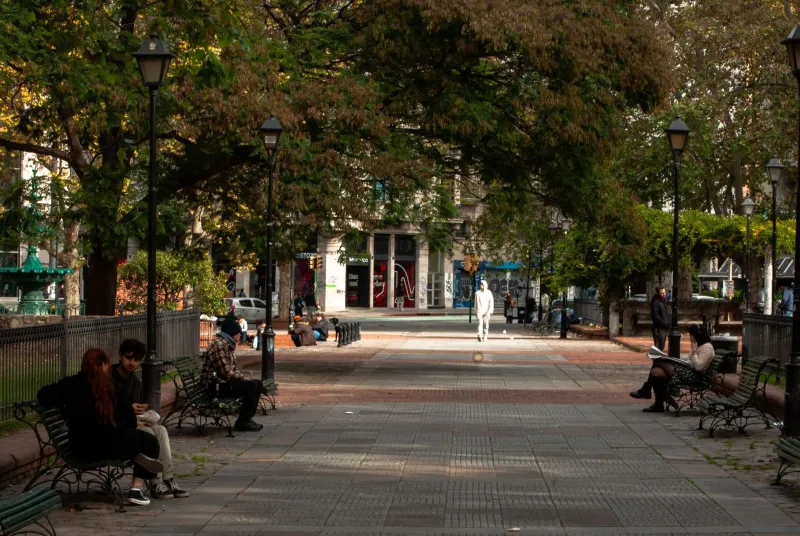
Start with the humblest object in the streetscape. Bench placement is one of those things that sounds trivial until you notice how often it's done badly. A bench facing a parking lot says: this is a waiting room. A bench facing a planter, a storefront, a splash pad, or a row of trees says something else entirely.
The international gold standard remains Bryant Park's movable chairs, a fixture in Midtown Manhattan since the early 1990s. The genius wasn't the chair itself — it was the permission to drag it wherever you wanted. Dozens of cities have since borrowed the idea, from small-town plazas in the Midwest to waterfront promenades in the Pacific Northwest. A related trick is the long communal bench with no armrest dividers in the middle, which lets three strangers sit together without anyone formally deciding to sit together.
In the UK, guerrilla 'bench bombing' campaigns have installed unauthorized seating on unloved corners, usually with a polite note explaining why. In the US, the same instinct shows up in the parklet boom — former parking spaces converted into tiny platforms with tables and shade. It's a cheap trick. That's the point. A bench costs less than a stoplight and does more for a block's mood.
The Turn You Can't Take
If benches are the carrot, restricted turns are the quiet stick. Anyone who has walked through a downtown intersection knows the specific dread of a right-turn-on-red: the car that inches forward while you're still crossing, the driver looking left for a gap rather than right at you.
Several American cities have begun restricting or banning right turns on red at busy pedestrian crossings, and a few have gone further with 'no-turn' signal phases that simply hold traffic while people walk. New York, Seattle, and Boston have all experimented with protected intersections — geometry that makes eye contact between driver and pedestrian the default rather than a lucky accident. The result, counterintuitively, is often faster for everyone. Fewer mid-block surprises, fewer fender benders, fewer people idling at a light they were never going to clear.
Barcelona's superblock experiment, which began in the mid-2010s by closing selected streets to through-traffic, is the famous version of this idea. The American translation is smaller and scrappier: a left-turn lane turned into a painted plaza, a slip lane removed, a block of asphalt closed to cars on summer weekends.
The Timer That Tells the Truth
Here's one you can test this afternoon. Next time you stand at a crosswalk, count how long the walk signal actually gives you. Some cities are generous. Others are theatrical.
An honest countdown clock is a small act of civic respect. So is a leading pedestrian interval — the three-to-seven-second head start walkers get before cars are released — which has spread quietly through US downtowns over the past decade and is now baked into many complete-streets guidelines. So is the pedestrian scramble, where all vehicle traffic stops at once and people can cross in any direction, diagonal included. Los Angeles, Denver, and New York have all run scramble pilots at high-foot-traffic corners, and the format keeps resurfacing because it works.
The common thread: when a city stops pretending pedestrians are an afterthought, people behave differently. They walk more. They cross where they're supposed to. They stop treating the crosswalk like a dare.
The Street That Pretends It's a Room
The Dutch have a word — woonerf — for a street designed to feel like a shared living room rather than a car corridor. Curbless paving, planters, low speeds, and an unspoken social contract that the person on foot wins. Versions of this have popped up in Seattle, Cambridge, and a growing list of smaller cities under names like 'shared streets' and 'neighborhood greenways.'
None of these interventions is dramatic on its own. A planter here, a coat of paint there. But stack five of them on one block and the block changes character. Traffic slows not because of a sign but because the street no longer looks like a place to hurry through.
Why Now
Three forces have pushed American cities toward these small-scale fixes. The first is money: paint, bollards, and benches are cheap, and federal grant programs launched in the early 2020s made them cheaper. The second is data — study after study has found that slower vehicle speeds and more foot traffic correlate with higher retail spending on a given block, which tends to win over the merchants who were initially skeptical. The third is simpler: after years of watching people rediscover their own downtowns, city halls noticed that the blocks people liked best were the ones where they could comfortably stand still.
What to Spot in Your Own Downtown
You don't need a planning degree to read the signs. Look for benches without center armrests, especially ones facing something other than a road. Look for crosswalk countdowns that start above 20 seconds, and for that brief head start before the light turns green. Look for a 'No Turn on Red' sign with a fresh blank plate bolted over the old one — that's a city changing its mind in public. Look for a parklet where a parking spot used to be, or a curb extension painted in a color that isn't strictly necessary. These are the fingerprints of a city deciding, block by block, that a five-minute pause is a feature rather than a bug.
Slowness, it turns out, is not something you have to be born with. It can be built. And increasingly, it is being built about four blocks from your apartment.